
Feast of Tabernacles
Birgit Barandica
October 2008
Sukkot begins five days after Yom Kippur (the Day of Atonement), on the 15th day of Tischri, the day of full moon in September/October, and lasts for seven days.
With Pessach and Shavuot, Sukkot is one of the pilgrimage feasts, meaning those feasts where people in the times of the first and second temple went up to Jerusalem to sacrifice in the temple.
On one hand it is a harvest feast where people thank God for the last harvest and pray for rain in the season to come, but basically, at Sukkot people remember the 40 years in the desert, "Celebrate this as a festival to the LORD for seven days each year. This is to be a lasting ordinance for the generations to come; celebrate it in the seventh month. Live in booths for seven days: All native-born Israelites are to live in booths so that your descendants will know that I made the Israelites live in booths when I brought them out of Egypt. I am the LORD your God" (Leviticus 23:41-43). So this feast is to be celebrated forever - from everyone belonging tp the people of God, also we Christians who are grafted in!
And in Deuteronomy 16,13-15, it is written again in a beautiful way, "Celebrate the Feast of Tabernacles for seven days after you have gathered the produce of your threshing-floor and your winepress. Be joyful at your Feast- you, your sons and daughters, your menservants and maidservants, and the Levites, the aliens, the fatherless and the widows who live in your towns. For seven days celebrate the Feast to the LORD your God at the place the LORD will choose. For the LORD your God will bless you in all your harvest and in all the work of your hands, and your joy will be complete." So, everybody shall know the true promise of this feast - including workers and employees, nobody shall work, but enjoy the celebration!
At Sukkot we remember the 40 years of wandering in the desert and that also in this life, we are wandering about. The only stable thing is God Himself, who walks with His people of which we as grafted in believers are part! The sukka symbolizes the temporary dwelling of the Israelites in the desert, the same as life, which is only a short period before eternity.
We have Yeshua's (Jesus') promise that He Himself is preparing durable dwellings for us: "In my Father's house are many rooms ("dwellings" in the German translation); if it were not so, I would have told you. I am going there to prepare a place for you. And if I go and prepare a place for you, I will come back and take you to be with me that you also may be where I am" (John 14:2-3) - the dwelling of God among us, as Revelation 21:3 says!
So, first a look back in order to remember how God has savely lead the Israelites through the desert. And then the prophetic look foreward, in expectance of the soon return of the Messiah Yeshua! And even when He is back here on earth, Sukkot is being observed, "Then the survivors from all the nations that have attacked Jerusalem will go up year after year to worship the King, the LORD Almighty, and to celebrate the Feast of Tabernacles." (Zechariaha 14:16).
Tabernacles itself as the wedding supper of the Lamb (Revelation 19,9): the groom Yeshua, who comes for His bride (the church)! What an outstanding prophetic parallel...!
Prophetic Look on the Future Wedding
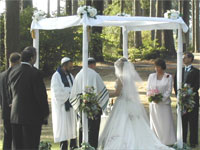
According to a Jewish saying, Rosh HaShana is the engagement, Yom Kippur the sealing and Sukkot the wedding in the relationship with God. A Jewish wedding lasts for seven days, the marriage takes place under a Chupah, a pavilian roof, which sometimes is depicted with a Tallit (Jewish prayer shawl). Thus, the sukka can be interpreted in the look ahead as that chupah and the seven day long Feast of
Sukkot is also a harvest feast - the vintage - and Yeshua said: "I am the vine; you are the branches. If a man remains in me and I in him, he will bear much fruit; apart from me you can do nothing" (John 15:5)!It is most likely that the time around Tabernacles is Yeshua's real birth date! Read more details about this in the article on Christmas!
It is awesome how Yeshua is the perfect fulfillment also in this feast! As the last one of the seven biblical feasts, Sukkot is yet the only one which has not yet come to fulfillment. Yeshua sacrificed Himself as an atonement for us (Pessach), became the First Fruit by His Resurrection (Chag HaBikurim = Feast of the Firstfruits), the Holy Spirit came (Shavuot), we are written in the Lamb's Book of Life and we are forgiven (Yom Kippur). Yet the Wedding Supper of the Lamb is yet to come...!
[Sukkot is the plural form of sukka = the Tabernacle]
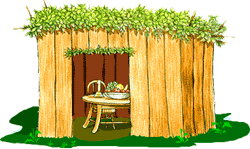
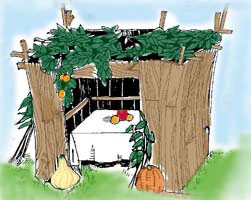
The sukkah is a simple hut which must be easily constructed or taken off, similar to those while wandering through the desert. It is to protect people and give them shade, yet not to hinder them in going on and to seperate them from nature. So it should have at least three side walls consisting of poles, cloth or planks. The roof shall not be covered heavily, it must give shade but stars must still be seen through it. It must be covered with plants, reed or branches with leaves, but not with planks. Sukkot are being build in backyards, porches, even on balconies. In this clip you can see where you can find them in Israel:
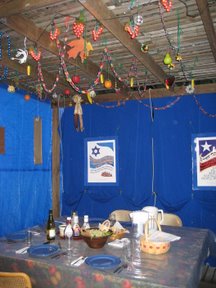
The sukkah must be big enough to have a convivial gathering, where people can eat and even sleep in (if the weather allows it). Those living in cold countries sometimes arrange and decorate their sanctuary as a sukkah. It shall be nicely decorated and there is no limit to fantasy: it is decorated with fruits, garlands, banners, fabrics and colored lights around colored and transparent windows. In the middle of the room is a festively set table.
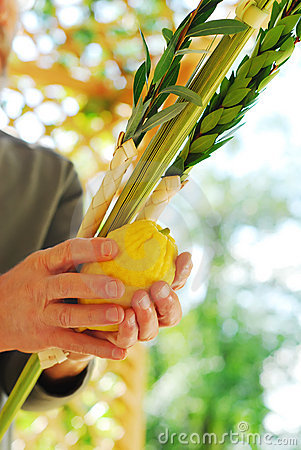
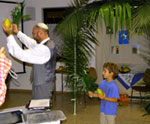
Special fronds are bound, called "lulav", which are the four species used in the daily prayer services consisting of a palm branch, three myrtle branches and two willow branches, and a particular citrus fruit, called Etrog. According to the Talmud (Jewish rabbinical literature on Torah), the etrog is the forbidden fruit of the tree which Adam ate in paradise. The frond is shaken toward all directions, like sort of a swing sacrifice as a symbol of a hearvest sacrifice, but also of a reconciled people gathered from all four ends of the earth praising the LORD (Yahweh) together, as a new creation in HIM. day, the priest was taking water from the well of Shilo and poured it onto the altar while praying for rain. It is the day of which we read in John 7:37 and 38; "On the last and greatest day of the Feast, Jesus stood and said in a loud voice, If anyone is thirsty, let him come to me and drink. Whoever believes in me, as the Scripture has said, streams of living water will flow from within him." So this took place on the last day of Sukkot."
And happiness is a must! Exodus 23:40 says; "On the first day you are to take choice fruit from the trees, and palm fronds, leafy branches and poplars, and rejoice before the LORD your God for seven days." Joy! All three feasts, where the people should come up to Jerusalem, to the temple, were celebrations of great joy! Another tradition is the ladling of water. It happens on the last day of the feast. This day is known as Hoshana Raba, 'Great Hoshana'. On this
Also Yeshua observed the Feast of Tabernacles (John 7), it was important to Him. While Jews are celebrating Sukkot in expectancy of the first coming of the Messiah, Messianic believers celebrate it anticipating His return as the Lion of Judah, as King of Kings, as Lord of Lords! And then it will come to pass what is prophetized to us in Zachariah 14:16, "Then the survivors from all the nations that have attacked Jerusalem will go up year after year to worship the King, the LORD Almighty, and to celebrate the Feast of Tabernacles." Which means that this feast will be observed also after the return of the Messiah!!!
There is another point for the eternal significance of Sukkot that we can read about in Revelation 21:3-4, "And I heard a great voice out of heaven saying, Behold, the tabernacle of God is with men, and he will dwell with them, and they shall be his people, and God himself shall be with them, and be their God."
So Sukkot points toward the Millenium! The Tabernacle with men - the Son of God coming back and tabernacles with His people, the Jews and the Non Jews!
be a day of great joy for all those of us who know the love of Yeshua – both, Jews and believers of the nations ...
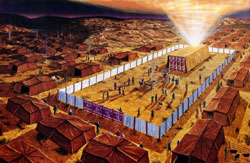
This "Tabernacle of God" is called Mishkan in Hebrew (Exodus 25-27). Like those sukkot, also the Mishkan was built up and torn down, every time when the Israelites moved on or paused. In the desert, God dwelled there with the Israelites, who settled in their tabernacles, their sukkot, around this Mishkan. Thus, on that day of the feast, the whole world will become the Mishkan of God, and HE will reign for all eternity! This will ~~~~~~~~~~~~~~~~~~~~~~~~~~~~~~~~~~~~~~~~~~~~~~~~~~~~~
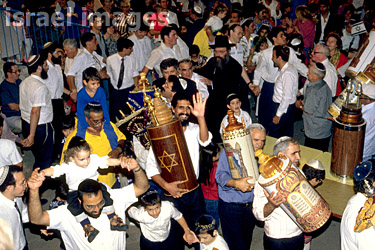
The eighth day of the Sukkot celebration is called Shmini Azeret which ends one day later with Simchat Torah, which literally means "Joy of the Torah". The torah scrolls are being taken out of the shrine and then people are dancing in great joy around them, everyone can hold them.
Simchat Torah is also being celebrated in Messianic congregations!
Messianic Believers Celebratin Torah
Rejoicing over the fact that God entrusted His people with the Torah, His Word, traditional Jews and Messianic believers alike get all Torah scrolls out of the shrine of their synagogue congregations. With those precious Torah scrolls in their arms, they sing and dance in processions around their congregation. This joyful celebration can take several hours; sometimes they even take to the streets. This is why this day is also known as "Joy of the Torah", "Simchat Torah". Jewish sages have determined that in honor of the Torah, there shall also be festive dinners.
And we remember John 1:1, which says, "In the beginning was the Word, and the Word was with God, and the Word was God" - The word was God - hence, Yeshua (Jesus)! So Yeshua is Torah!!!
Scriptures: Leviticus 23,34-35;39-43; Numbers 29,12-39; Deutoronomy 16,13-17